Old city
La Rambla & the Boqueria
Everyone tells you to skip La Rambla. We say walk it once, with your hand on your bag, and then turn off it into the market — where the real city is still trading.
Let's get the awkward part out of the way. La Rambla is touristy, overpriced, and the densest pickpocket strip in Barcelona. Locals cross it rather than stroll it. The restaurants flanking it serve frozen paella to people who don't know better, and the menu boards with photos of the food are a reliable warning sign. None of that is a secret to anyone who lives here.
And yet. You should still walk it once.
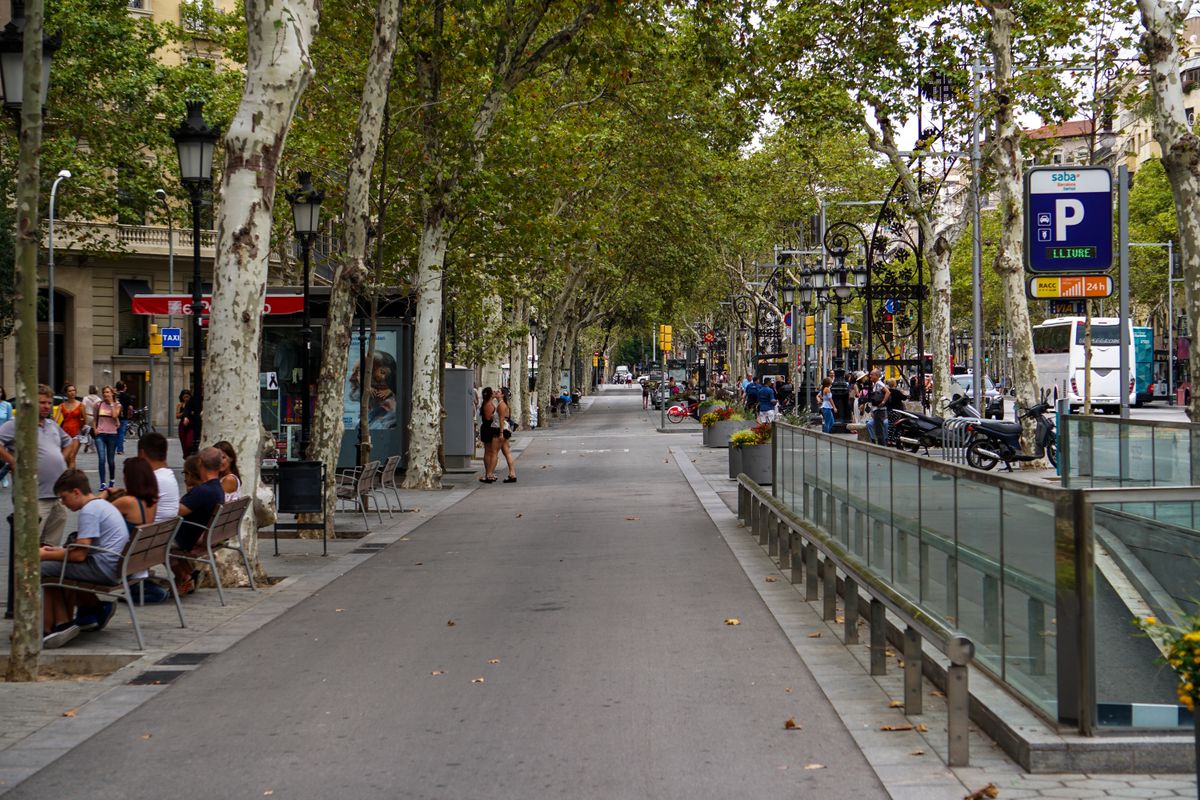
The 1.2-kilometre promenade runs downhill from Plaça de Catalunya to the Columbus monument at the port, under a canopy of plane trees that have shaded the strip since the mid-1800s. It is theatre — flower kiosks, human statues, a constant churn of every nationality on Earth — worth seeing once even when the ticket is overpriced. Treat it as a corridor, not a destination: a place you move through on the way to the Boqueria or the harbour, not somewhere you sit down and spend money.
Four things actually worth a glance
Most of La Rambla is noise. A handful of fixed points are worth slowing down for, and you can tick them all off in a twenty-minute walk without spending a euro.
- The Canaletes fountain, near the top by Plaça de Catalunya — a cast-iron drinking fountain wrapped in legend. Drink from it, the story goes, and you'll come back to Barcelona. It's also where football fans gather to celebrate, so it has a real place in the city's affections.
- The Joan Miró pavement mosaic at Pla de l'Os, roughly halfway down by the Boqueria entrance. People walk over it without noticing; look down and you're standing on a signed work by one of Catalonia's great artists, laid into the ground in red, blue, yellow and black.
- The Liceu, the grand opera house on the right as you head toward the sea — twice burned, twice rebuilt, still one of Europe's serious stages.
- Plaça Reial, a few steps off the Rambla through an unassuming arch. A palm-lined square with lamp posts designed by a young Gaudí, ringed by arcades. Far more pleasant than the strip it hides behind.
That's the lot. Anything else along the way — the souvenir stalls, the €6 "sangria", the cup-shuffling con men — you can let slide past.
The Boqueria is the reason you came down here
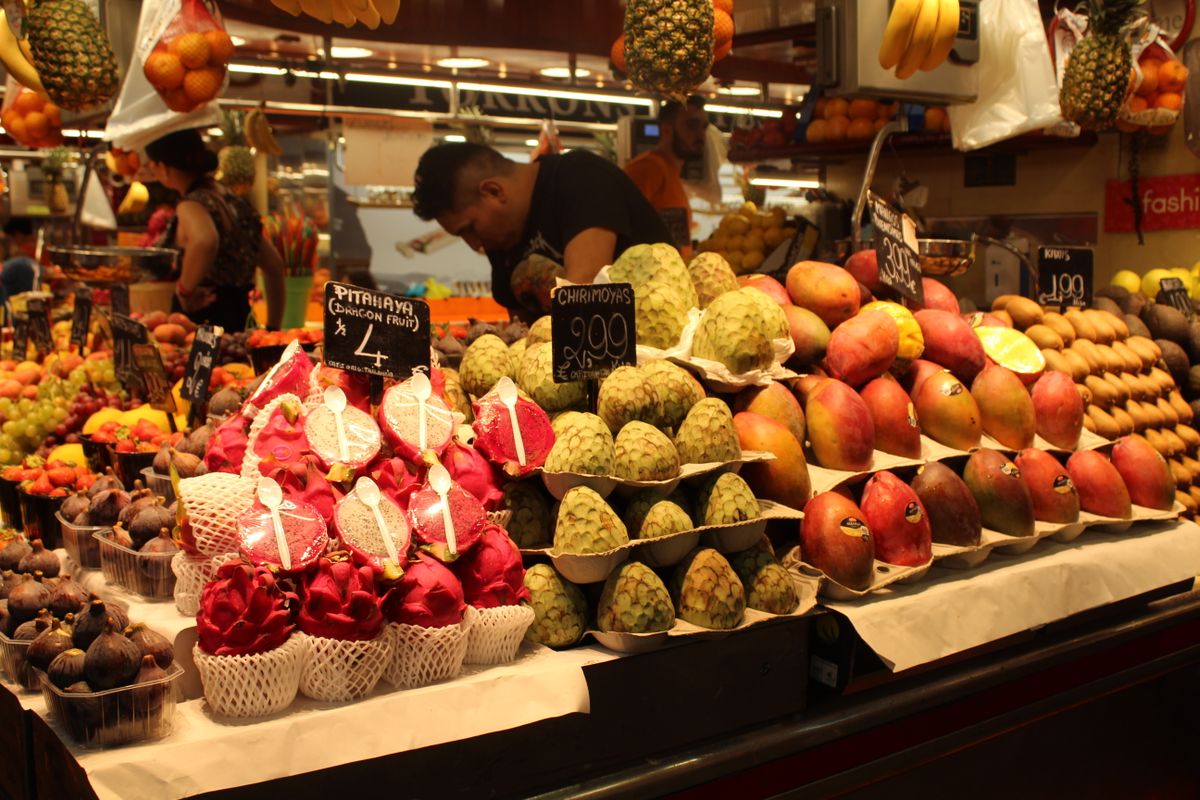
Turn off the Rambla through the wrought-iron and stained-glass gateway with its big Mercat de Sant Josep crest, and the temperature of the place changes. This is the city's most famous covered food market, trading on roughly this spot since the 1800s and selling food to actual Barcelonins long before any of us showed up with cameras. There are something like three hundred stalls: pyramids of fruit, towers of spices in saffron and paprika, whole legs of jamón hanging in rows, fish on ice that was swimming that morning.
Here is the thing nobody warns you about: the Boqueria has a front and a back, and they are two different markets.
The front, facing the Rambla, has reinvented itself for the crowds. Those glossy stalls selling little cups of pre-cut tropical fruit and "smoothies" exist because tourists will pay three or four euros for a paper cup of pineapple. The fruit is real; the price is a tax on convenience and a good photo. The locals doing their actual shopping walk straight past it.
The front of the Boqueria sells you a snack and a photograph. The back sells you breakfast. Walk the extra fifty metres and you'll eat better, pay less, and stand next to people who came here to buy fish, not to film it.
Eat at the back, standing up, before ten
The market's small bar counters are where it earns its reputation, and the ones to aim for are tucked deeper inside. Bar Pinotxo, just inside the main entrance on the right, has been frying up breakfast for generations and is something of an institution. El Quim de la Boqueria is the other name people swear by — order the fried eggs with baby squid if there's a stool free, which there often isn't.
You sit on a stool at a steel counter, the cook is a metre away, and whatever lands in front of you was bought from a stall ten paces behind your back. It's not cheap — this is a famous market in a tourist city — but it's honest cooking at a fair price, which is more than the Rambla restaurants can claim.
Timing is the whole game. Come early. By nine the market is humming and you can still move; by noon it's a crush of selfie sticks and slow-walking groups, the good counters have a queue, and the experience curdles. Treat it as a breakfast errand, not a midday outing. A quiet morning here pairs naturally with a slow lunch later — a plate of Catalan tapas and a glass of vermouth in a quieter neighbourhood once the heat builds.
Where not to put your wallet
Pickpockets work La Rambla and the Boqueria entrance with real skill, and the busier it gets the better they like it. None of this should scare you off — it's straightforward to avoid — but a little caution saves a bad afternoon.
My rule of thumb, after enough crowded mornings here:
- Carry your bag across your body and swung to the front, especially in the squeeze at the market gate. A backpack on your back is an open invitation.
- Keep your phone in a front pocket or a zipped bag, not loose in your hand while you film the jamón.
- Be wary of anyone who gets unexpectedly close, offers you a flower, or asks you to sign a petition — classic distraction setups.
- Do not, under any circumstances, sit down to eat on the Rambla itself. The food is bad and the bill is worse.
That last one isn't a safety point, just a quality one, but it belongs on the list. The terraces lining the promenade are the single biggest tourist trap in the old city. If you're hungry, the Boqueria's back counters or any side street off the strip will treat you better. From the bottom of the Rambla you're also a short walk into the tangle of the Gothic Quarter, where the eating gets more interesting.
So, is it worth it?
Walk La Rambla once, in daylight, for the spectacle of it — the trees, the mosaic, the parade of humanity — and then leave it behind and don't go back. It's a thing to have seen, not a place to linger. The Boqueria is the opposite: genuinely wonderful, as long as you arrive early, head for the back, and skip the cup of cut fruit at the door. Get the timing right and you'll understand why the market has survived two centuries of the city changing around it.
For opening hours and the official line, the city pages on the Boqueria market and La Rambla are a reasonable start, and the background on La Rambla fills in the history of those plane trees. Everything else is just what we'd tell a friend stepping off the train at Plaça de Catalunya: head down, look up at the trees once, then turn into the market and eat.