Sea & hill
Montjuïc
A green hill over the port stacked with a national art museum, a fortress with a grim past, and a fountain that still puts on a show. It rarely makes the top of anyone's list, and that is exactly its appeal.
Most first-time visitors arrive in Barcelona with a Gaudí checklist and leave without ever climbing Montjuïc. We think that is a small tragedy. This hill holds the city's best collection of medieval painting, a castle you can walk the ramparts of, the Olympic stadium from 1992, and a fountain that throws light and water around to music on summer evenings. Fold the worthwhile parts into one relaxed half-day, and the rooftop views cost nothing. Here is the honest version — the kind we wish someone had handed us the first time we got off the funicular wondering which way was up.
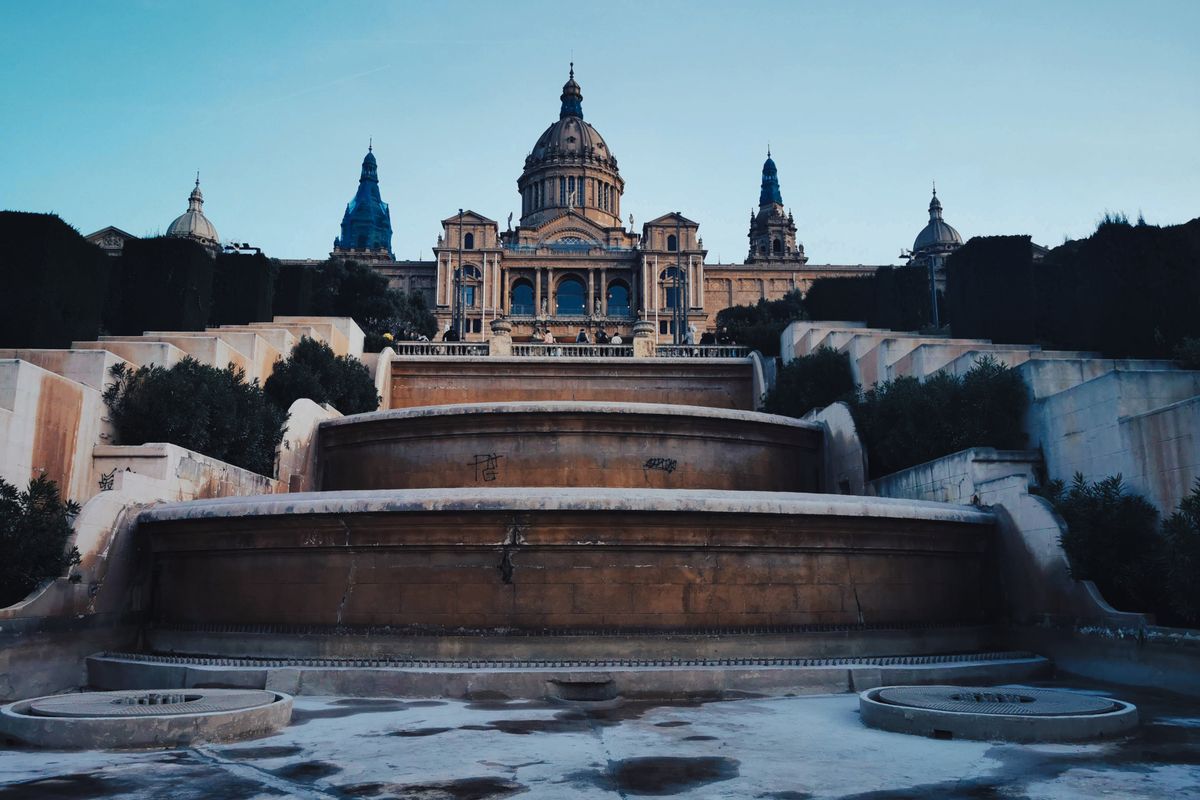
The MNAC, and why the frescoes alone justify the trip
The Palau Nacional is the enormous domed palace built for the 1929 International Exhibition, and it now houses the Museu Nacional d'Art de Catalunya — the MNAC. From the foot of the hill it looks like a wedding cake parked on a terrace. Worth the photograph for the building; worth the ticket for the Romanesque collection inside.
What makes it special: in the early twentieth century, conservators stripped fragile twelfth-century frescoes off the walls of crumbling Pyrenean churches and remounted them here, reconstructing the curved apses they were painted on. So you stand inside the shape of a mountain chapel, looking up at a Christ in Majesty that has stared down worshippers for nine hundred years. The one from Sant Climent de Taüll, with its huge, calm, almond eyes, is the piece people travel for. Gothic painting, a strong modernisme section and a rooftop terrace round it out — but if you only have an hour, give it to the Romanesque rooms.
The frescoes are the single most underrated thing we send people to in Barcelona. No queue, no crowd selfies, no jostling — just a quiet room and a painting older than almost everything else you will see all week.
Hours shift with the season, and the museum runs free-entry windows on certain afternoons and the first Sunday of the month. The current timetable lives on the museum's own site, and it is the only source we would trust for the day you actually go.
The Magic Fountain — check it's running before you commit
Down the slope, on the axis between the palace and Plaça d'Espanya, sits the Font Màgica. On show nights it pushes coloured water into the air in time with music while a crowd gathers on the steps to watch. Free, genuinely good fun, and it photographs beautifully against the lit-up palace behind it.
The catch is reliability. Years of drought across Catalonia kept the fountain switched off for long stretches, and it only came back to a regular schedule in late 2025. Even now the shows run a limited number of evenings — generally Thursday through Saturday — with start times that slide earlier in winter and later in summer, and any of them can be cancelled for water restrictions, wind or maintenance.
Do not build your whole evening around the fountain on the assumption it will be on. We have watched disappointed couples turn up to a silent, dry basin on a Tuesday. Confirm the day and time on the city council's fountain page the same afternoon you go.
When it does run, arrive twenty minutes early for a spot on the low steps facing the palace, and stay for two or three song cycles rather than the whole hour. Novelty fades; the opening sequences are the best of it.
The castle: a view with an uncomfortable history
The fortress at the top, the Castell de Montjuïc, is the part most people misjudge in advance. They expect a romantic medieval keep. What they get is a low, blunt military star-fort, much of it eighteenth-century, that for generations was pointed not out to sea but down at the city it was meant to control.
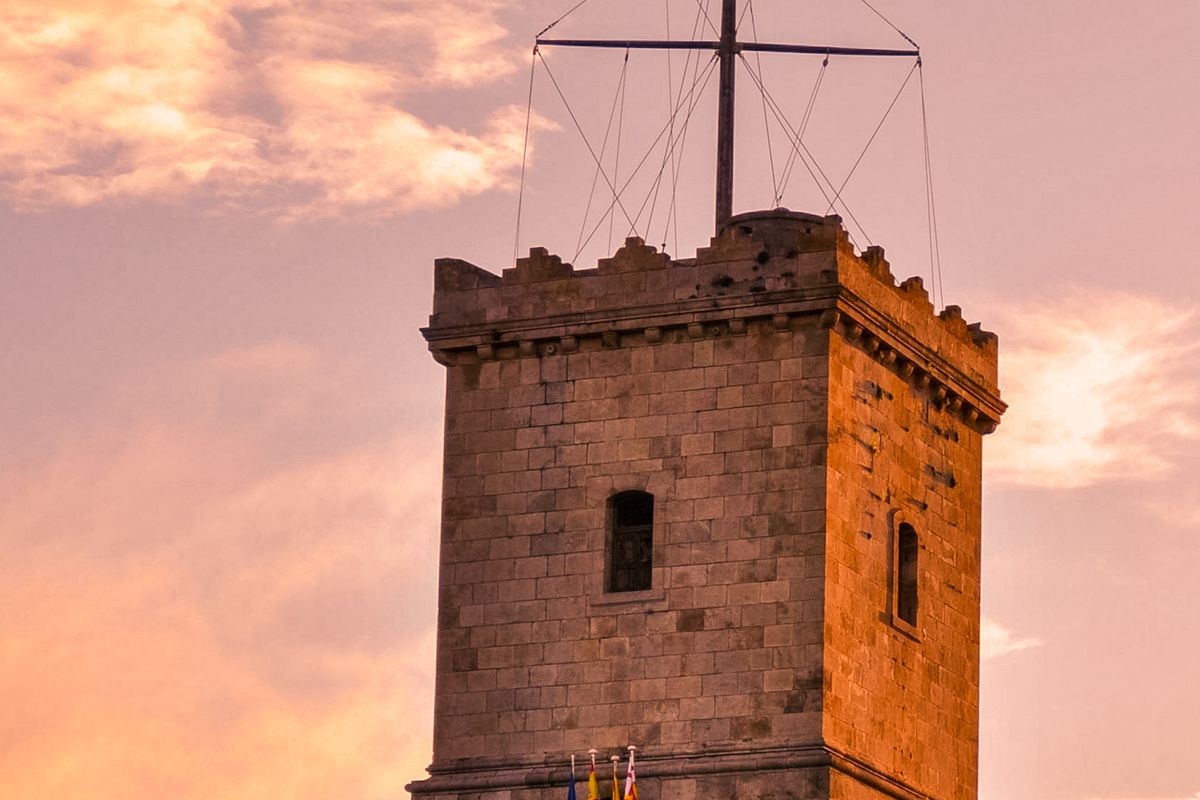
That history is dark, and the place does not hide it. Political prisoners were held and executed here across the turbulent twentieth century; the most remembered was Lluís Companys, the president of Catalonia, shot in the moat in 1940. Today the grounds are a quiet park, the dry moat planted and walkable, and the ramparts give you a clean sweep over the commercial port, the container cranes and the sea beyond.
Our take, plainly: go for the walk around the walls and the harbour view, not for the rooms inside, which are sparse. Adult entry runs around €12, under-16s are free, and the upper terrace is the payoff. A strange, calm place to stand — half a viewpoint, half a memorial — and worth the half hour even if the building underwhelms.
Olympics, Miró and the gardens, if you have legs left
Between the museum and the castle, the hill keeps going. A short list of what's up there, in rough order of how much we'd push you toward it:
- Fundació Joan Miró — a bright, well-designed gallery of the artist's work in a building made for it. Best museum on the hill after the MNAC, and a calm one.
- The 1992 Olympic ring — Estadi Olímpic, the swooping white Calatrava telecommunications tower beside it, and the diving pool with the city as a backdrop. More atmosphere than attraction; pleasant to wander, free to look at.
- The gardens — terraced botanical and ornamental plots drape the slopes, cool and shaded on a hot afternoon. Easy to skip, lovely if you stumble into them.
- Poble Espanyol — a 1929 model "Spanish village" of replica architecture. Touristy and ticketed; we'd take it or leave it.
Nobody sees all of this in one go, and you shouldn't try. Pick the museum, the castle, and one of the rest.
Getting up the hill without a slog
Montjuïc is high enough that walking up from Plaça d'Espanya is a sweaty mistake in summer. Better ways exist, and they're half the fun:
- The Montjuïc funicular — runs underground off the Paral·lel metro station and is covered by an ordinary metro ticket. Fastest, cheapest, no view, but it does the climbing for you.
- The Telefèric de Montjuïc — a small gondola from the funicular's top station up to the castle, with the city dropping away beneath you. Separate ticket, around €14–15 return, genuinely scenic.
- Bus 150 — loops up past most of the sights from Plaça d'Espanya, handy for hopping between the museum, gardens and castle without walking the slopes.
- The harbour cable car — the old Transbordador Aeri swings across the port from Barceloneta to the lower flank of the hill. Pricey and often queued, but the over-water crossing is a small adventure in itself.
For how the funicular, metro and buses knit together with the rest of the city, our guide to getting around Barcelona lays out the tickets and passes worth buying.
A half-day that holds together
Here's the shape we'd give it. Take the funicular up in the early afternoon and start at the MNAC, giving the Romanesque rooms their due and ending on the rooftop terrace. Walk or ride the gondola to the castle for the late-afternoon light and the harbour view, then drift back down through the gardens. Only if the schedule says the fountain is running that night, end on the steps below the palace for the show.
That is a full, unhurried afternoon and evening, and it leaves the morning for whatever Gaudí pilgrimage you came for. If the Sagrada Família and Park Güell are the loud, crowded headliners of a Barcelona trip, Montjuïc is the quiet B-side — the hill where you can hear yourself think, see a painting that predates the city's tourism by eight centuries, and look down on the whole sprawl from a fortress wall. Underrated next to the Gaudí circus, and we'll keep saying so until people start climbing it.